Understanding Quality Management Maturity

What QMM is, Implications for Patients and Public Health
By Kamal Biswas · Regller
What Is Quality Management Maturity?
Quality Management Maturity, or QMM, describes how well an organization’s quality system actually functions over time — not whether it meets the minimum required, but how reliably, intelligently, and sustainably it produces quality outcomes. Maturity is the difference between a quality system that exists on paper and one that actually learns from its own data, adapts to disruption, and improves the work it governs. The first is a compliance artifact. The second is an operating capability.
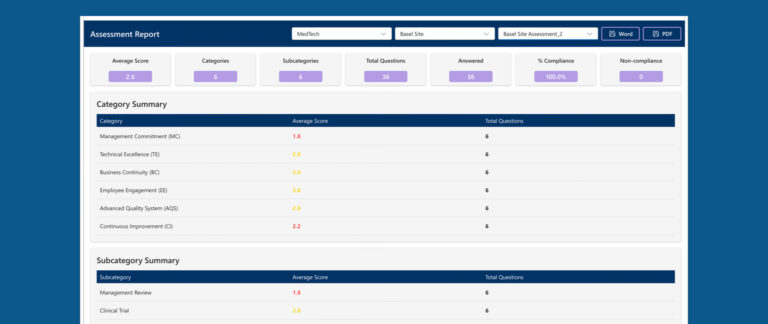
FDA’s Center for Drug Evaluation and Research formalized QMM as a structured framework for evaluating pharmaceutical manufacturing establishments. The framework groups the qualities of a mature quality system into five practice areas: Management Commitment to Quality, Business Continuity, Advanced Pharmaceutical Quality System, Technical Excellence, and Employee Engagement and Empowerment. Each practice area can be scored, observed, and improved — which means quality maturity, historically treated as a soft attribute, is now treated as a measurable property of the organization.
This shift in framing matters because it changes what organizations and regulators can ask of each other. Under a compliance frame, the only meaningful question is whether the rules are being followed on the day of inspection. Under a maturity frame, the questions become broader and more useful: how reliable is the system, how quickly does it learn, how resilient is it to disruption, how engaged are its people, how trustworthy is its data? These are the questions that distinguish a quality program that produces durable outcomes from one that produces only documentation.
Why Quality Maturity Has Become a Strategic Concern
For most of the last several decades, quality conversations were dominated by compliance: whether the organization could pass an inspection, close a CAPA, and defend a batch record. Compliance was necessary, it was visible, and it was enforceable — and so it absorbed nearly all the attention. Maturity was treated as a virtue rather than a system.
Several pressures have pushed maturity from virtue to system. Persistent drug shortages have made supply reliability a public-health priority, and analysis of the underlying causes has consistently traced shortages to quality problems and manufacturing delays at sites that were, by definition, compliant. Recall costs, both direct and reputational, have grown. Hospital systems, group purchasing organizations, and federal purchasers have started weighting reliability alongside price in their procurement decisions. Investors and rating agencies have begun asking quality questions that were previously the domain of inspectors. And regulators have begun recognizing that inspection, however rigorous, cannot by itself identify the deeper organizational properties that determine future quality outcomes.
The result is a converging consensus that compliance is necessary but not sufficient. Mature quality is increasingly understood as a competitive asset, a procurement criterion, an investment signal, and a regulatory differentiator — not just a moral commitment. The organizations that recognize this shift early are positioning themselves to capture its value; the organizations that continue to treat quality as a compliance function are positioning themselves to lose ground.
The Five Practice Areas, Explained
The five QMM practice areas describe the dimensions across which a quality system either is or is not mature. Each is worth understanding in its own terms.
Management Commitment to Quality is the practice area that begins at the top. It asks whether leadership treats quality as a strategic priority backed by real resources, or as a compliance overhead managed at arm’s length. Effective management reviews, resource allocation aligned to quality risk, clear connections between business strategy and quality objectives, and consistent communication of quality priorities from senior leadership all feed this area. The mature organization treats quality conversations the same way it treats financial conversations: structured, frequent, and consequential.
Business Continuity asks whether the establishment can plan for and sustain operations through disruption — both expected disruption like planned maintenance and supplier transitions, and unexpected disruption like pandemics, geopolitical events, or critical infrastructure failures. Demand forecasting, supplier qualification and risk management, contingency planning, single-source mitigation, and scenario planning all sit here. A site that produces a perfect batch today but cannot continue producing it after a single supplier disruption is mature on one dimension and immature on another.
The Advanced Pharmaceutical Quality System practice area is where data-driven quality lives. It evaluates CAPA effectiveness, change-management maturity, knowledge management across products and lifecycle stages, complaint and deviation analytics, and the integration of risk-based thinking into operational decisions. The word “advanced” is doing real work in the practice area’s name: it distinguishes establishments that learn from their data from those that merely produce it. A mature PQS does not just record deviations; it identifies patterns, prevents recurrence, and translates learnings into systemic improvement.
Technical Excellence rewards the adoption of advanced manufacturing and analytical methods, process analytical technology, continuous manufacturing, modern data governance, and AI-enabled analytics. It also captures process optimization, technological currency, and the technical depth of the workforce. This is the practice area most associated with capital investment, but capital alone does not produce maturity here. A site can have state-of-the-art equipment poorly integrated with weak data infrastructure and still score low; conversely, a site with disciplined, well-instrumented older equipment can score high.
Employee Engagement and Empowerment asks whether employees at all levels understand their role in quality, feel safe to escalate concerns, and are recognized for contributions to improvement. It evaluates ownership and empowerment, internal communication, and rewards and recognition. This is the practice area most often dismissed as soft and most often determinative of actual quality outcomes. A workforce that does not escalate is a workforce that allows small problems to become recalls.
What QMM Is Not: The Difference From Compliance
Understanding what QMM is requires understanding what it is not. QMM is not a substitute for current good manufacturing practice (cGMP), the enforceable regulatory floor below which medicines cannot legally be produced. It does not replace inspection. It does not measure batch-level outcomes or specific deviations. A QMM assessment cannot find an establishment non-compliant, and a cGMP-compliant establishment can still receive a low QMM score.
The two frames answer different questions. cGMP asks whether the establishment is meeting the rules on the day of inspection. QMM asks whether the system that produced today’s compliant batch will reliably produce tomorrow’s. The first is a snapshot; the second is a trajectory.
cGMP asks whether a facility meets the rules. QMM asks whether the system that produced today’s batch will reliably produce tomorrow’s.
This distinction has structural consequences. Inspections are episodic by design — bounded by what is in scope on the day and excellent at confirming whether documented controls were executed, but structurally less suited to detecting whether the underlying system is learning. cGMP focuses on artifacts: documented procedures, signed records, validated processes, traceable batches. QMM focuses on behavior: whether leaders actually engage with management reviews, whether CAPAs actually prevent recurrence, whether employees actually escalate, whether data actually drives action. Both frames are necessary. Neither is sufficient on its own.
The Benefits of Quality Maturity
Organizations that develop and demonstrate quality maturity capture value across several dimensions. Some benefits are immediate and operational; others are strategic and accumulate over years.
Operational benefits. A mature quality system produces fewer deviations, faster CAPA closure, more effective change management, and stronger lifecycle knowledge. Each of these reduces direct quality cost. Equally important, a mature system reduces the variability that drives operational disruption: fewer surprises in audits, fewer escalations to senior management, fewer cross-functional rework cycles. Internal teams spend more time on improvement and less on firefighting.
Supply reliability. Mature quality systems prevent the quality-driven disruptions that cause shortages, recalls, and delivery failures. For organizations serving hospitals, retailers, or large customers with reliability-sensitive contracts, this translates directly into supply continuity and customer trust.
Regulatory advantages. Regulators have signaled that establishments demonstrating advanced quality maturity may benefit from reduced inspection frequency, expedited reviews of product submissions, and regulatory flexibility for post-approval changes consistent with established lifecycle-management frameworks. For organizations with broad portfolios and frequent post-approval changes, the operational and time-to-market value of these flexibilities can be substantial.
Commercial differentiation. Procurement decisions by hospital systems, pharmacy benefit managers, group purchasing organizations, and federal purchasers increasingly weight reliability alongside price. Quality maturity is becoming a procurement signal — first informally, then increasingly in contractual terms. Organizations with demonstrable maturity gain access to contracts and partnerships unavailable to organizations that compete on price alone.
Investor and capital-market signals. Investors, lenders, and rating agencies are beginning to ask quality-maturity questions in due diligence, particularly for organizations whose value depends on reliable supply and regulatory standing. A mature quality system reduces the perceived risk profile of the organization, with measurable consequences for cost of capital.
Workforce outcomes. Mature quality systems are also better places to work. Employees who feel empowered, who see their input acted on, and who are recognized for contributions to quality outcomes show measurably higher engagement and lower turnover. In a labor market where pharmaceutical talent is scarce, this is a meaningful operational advantage.
Long-horizon resilience. The deepest benefit is also the hardest to measure: a mature quality system is one that adapts. As technology evolves, regulations shift, and supply chains restructure, mature organizations absorb change. Immature organizations are disrupted by it. Over a five-to-ten-year horizon, the gap between these two trajectories becomes the gap between organizations that thrive and organizations that struggle.
Implications for Industry
QMM is reshaping industry conversations at three levels.
At the firm level, quality is moving from a cost-of-doing-business function to a source of strategic advantage. Organizations that mature their quality systems early establish themselves as preferred suppliers, win contracts on terms unavailable to competitors, and reduce the regulatory friction associated with their product portfolios. Organizations that defer maturity work, by contrast, increasingly find themselves on the wrong side of procurement decisions, regulatory scrutiny, and capital allocation.
At the relationship level, the boundary between an organization and its quality function is shifting. Workforce engagement, succession planning, supplier resilience, capital investment in advanced manufacturing, and digital data architecture are now all subjects of quality-system evaluation. The traditional division between “the business” and “quality” becomes harder, and less useful, to maintain. Some organizations are responding by elevating quality leadership into broader operational ownership; others are redistributing quality accountability across the executive team. Both responses are valid; treating quality as a separate function reporting through QA alone is increasingly difficult to defend.
At the ecosystem level, quality maturity is becoming a shared language. Regulators, purchasers, investors, and partners are converging on a common set of questions about quality systems — and increasingly, a common set of expectations about how those questions should be answered. Organizations that develop fluency in this language are better positioned across every relationship they hold. Organizations that do not will increasingly find themselves explaining their quality posture in terms that the rest of the ecosystem has moved past.
Implications for the Quality Assurance Function
For QA professionals, the maturity frame substantially expands the role. Several shifts deserve attention.
From auditor to steward. The QA function has historically been measured on its ability to verify compliance, catch deviations, and assure release. The maturity frame asks something larger: can QA shape the system that produces these outcomes, not just verify them? The QA leader becomes a steward of organizational maturity — accountable not only for what releases today, but for whether the system will still be producing reliable releases three years from now.
New domains of fluency. Business continuity planning, supplier risk analytics, knowledge management across the product lifecycle, employee engagement methodology, and data governance for quality analytics are not traditional QA topics. Each maps directly to a maturity practice area or sub-element. QA training programs, competency frameworks, and team structures need to expand to match.
Translator of technology into quality outcomes. Mature quality systems reward evidence-based, data-driven decision-making. In practice this means disciplined use of computerized systems, validated data pipelines, and AI-enabled analytics. The Computer Software Assurance framework — with its risk-based, lean approach to validation — becomes a foundational competency for any data system supporting a quality-relevant decision. QA professionals not fluent in this framework will struggle to support the analytics that maturity scoring increasingly depends on.
A frame that travels across GxP boundaries. Although QMM originated in pharmaceutical manufacturing, the underlying lens — culture, continuity, data-driven systems, technical capability, engagement — applies just as fully to laboratory operations under Good Laboratory Practice and clinical operations under Good Clinical Practice. ICH Q9(R1), Q10, and Q12, alongside applicable ISO standards, already shape QA practice across GxP disciplines. Maturity thinking is migrating into these adjacent quality conversations, and QA professionals who internalize the frame early position themselves and their organizations to lead the migration.
Implications for Patients and Public Health
Quality maturity has a patient at its center, even when the regulatory framing makes it sound otherwise. When the supply of an oncology agent, a sterile injectable, or a pediatric formulation falters, the harm is concrete and clinical: postponed surgeries, substituted regimens, rationed care. By incentivizing maturity in the practices that prevent quality-driven shortages, QMM is, in effect, a public-health program disguised as a quality program. If it functions as designed, patients should experience fewer shortages, more predictable supply, and broader confidence in the medicines they receive.
There is a secondary benefit at the system level. Aggregate insights from maturity assessments inform regulators’ understanding of where the medicines supply is structurally fragile. That knowledge can shape policy — from procurement preferences to investment in advanced manufacturing — long before any individual establishment becomes a public concern. Quality maturity, in this sense, contributes not only to the reliability of individual sites but to the structural resilience of the broader healthcare system.
The Role of Technology and AI
The maturity practice areas implicitly reward digital capability. An organization cannot demonstrate an advanced quality system without integrated electronic records, deviation analytics, and CAPA effectiveness measurement. Technical excellence rewards process analytical technology, modern analytical methods, and the data infrastructures that support them. Business continuity hinges on supplier visibility and forecasting, both increasingly AI-assisted. Even the most ostensibly human practice areas — management commitment and employee engagement — are evaluated through data sources that an underdeveloped infrastructure cannot reliably supply.
Modern AI is changing what is possible at every layer of this stack. AI-enabled deviation classification, predictive quality analytics, computer-vision-based inspection, and natural-language summarization of long-form quality records are moving from pilot to production at leading organizations. Just as importantly, AI changes how maturity itself can be measured. Rather than reconstructing maturity scores once a year from after-the-fact data pulls, AI makes it possible to compute maturity continuously, drawing on signals as they emerge from operational systems. The most powerful applications combine AI with human judgment — AI synthesizes the signals at scale, and quality professionals adjudicate, contextualize, and approve. The result is faster, broader, and more defensible maturity insight than either humans or algorithms could produce alone.
There is a deeper architectural shift implied here. Quality has historically been instrumented as a discrete activity — release of a batch, closure of a CAPA, completion of an audit. Each is a discrete event producing a discrete record. AI and modern data architectures make it possible to instrument quality as a continuous state — a property of the system observable in something close to real time, the way operational performance has been instrumented for decades in other industries. This shift, from quality-as-event to quality-as-state, is the substrate on which the next generation of quality programs will rest.
How to Get the Best Out of QMM
Capturing the value of quality maturity is not the same as adopting a framework. Organizations that succeed at maturity development tend to share several practices, each of which can be adopted regardless of the formal status of any voluntary regulatory program.
Use the practice areas as a self-assessment lens. Before any external assessment, organizations benefit from honestly scoring themselves against the five practice areas. Most will identify uneven maturity — strong in some areas, weak in others. This unevenness is normal and informative. The pattern of strengths and gaps is the first input to any realistic improvement strategy.
Diagnose three variables before designing a strategy. The right path depends on industry context (the regulatory regime and product type), value-chain scope (which segment of operations carries the most quality risk), and the organization’s own cultural and maturity baseline. A quality-mature organization can move quickly to advanced scoring infrastructure because the underlying behaviors and data already exist. A compliance-focused organization must first build the behaviors that scoring will measure, or it will score poorly and disengage. The diagnosis matters more than the framework choice.
Anchor accountability at the asset level. Site-level or establishment-level scores are too coarse to drive operational ownership. Maturity programs that succeed at scale tend to score at the lowest meaningful asset level — line, suite, instrument, system, supplier — with named owners accountable for each score. The site-level number then emerges from disciplined asset-level ownership rather than being constructed from above.
Build the foundation before the platform. Many maturity programs fail in year two because they skipped foundation work in month two. Governance design, asset taxonomy, ownership assignments, and baseline data-quality assessment are unglamorous; they are also the difference between a program that scales and one that fragments. Resist the temptation to start with a platform decision.
Pilot narrow, then scale by design. The fastest path to a working maturity capability is a narrow pilot that succeeds, not a broad program that drifts. One site, one or two practice areas, the assets where data is best and ownership is clearest. The pilot proves the architecture; standardization and scale follow. Enterprise rollouts in year one are the most common pattern of preventable failure.
Treat AI as a force multiplier, not a substitute. AI is most powerful when it accelerates work humans are already doing well. The most effective AI deployments in quality maturity synthesize existing signals into draft scores that quality professionals adjudicate. Implementations that try to use AI to replace human judgment produce scores no one trusts; implementations that try to do maturity scoring manually at scale produce scores that are stale by the time they are computed. The right architecture combines both.
Plan for sustainment from the start. A high maturity score that erodes over the following year provides little durable value. Organizations that sustain maturity build governance structures that outlast any individual leader, integrate maturity reviews into routine operations, and treat improvement as a permanent capability rather than a project. Maturity is not a destination; it is a discipline.
Capturing the value of quality maturity is not the same as adopting a framework — and most of the value is captured by organizations that understand the difference.
The Continuous Maturity Horizon
QMM in its current form originated in pharmaceutical manufacturing, but the lens it introduces does not stay there. The maturity question — whether a quality system is functioning, learning, and improving over time — applies just as fully to laboratory operations, clinical-trial conduct, and supply-chain management within drugs. It applies to other regulated industries: devices, biologics, food, veterinary products. And it applies to the cadence of assessment itself, where AI-enabled signals can replace periodic attestation with continuous observation.
The destination has three dimensions. It is continuous across the value chain, meaning the same maturity lens applies at every operational stage rather than being concentrated at a single function. It is continuous across industries, meaning the framework travels into adjacent regulated domains rather than remaining confined to its origin. And it is continuous in time, meaning AI-enabled signals replace periodic attestation with ongoing observation — the way real-time operational metrics have replaced periodic operational reporting in other industries.
Organizations that begin building this capability now will, in two to three years, have working continuous-quality systems while their peers are still negotiating scope. The architecture, the data infrastructure, the asset taxonomy, the governance — all of it is harder to build under external pressure than during a period of voluntary engagement. The window for constructive, exploratory adoption is open. Organizations that use it well will define the standards by which others are later evaluated.
Where to Begin
For organizations starting to engage with quality maturity, three concrete moves are worth taking before any specific platform or framework decision.
First, conduct an honest internal readiness review across the five practice areas. The objective is not a final score; it is an accurate picture of where strengths and gaps actually sit. Most organizations will find the picture more uneven than they expected, which is itself useful information.
Second, define the asset taxonomy for the scope where maturity work will begin. What is an asset, who owns it, how do scores aggregate, and what does accountability look like? This work is unglamorous and easy to defer. It is also the foundation that determines whether subsequent investment scales.
Third, identify the narrow pilot scope where maturity work will start: one site, one or two practice areas, the assets where data is best and ownership is clearest. Resist the urge to start broad. Maturity programs that begin narrow and succeed produce far more value than maturity programs that begin broad and drift.
Quality maturity is not a regulatory burden to comply with. It is a strategic capability to develop, and the value it produces accrues to the organizations that develop it deliberately, with patience, and with realistic expectations about what is hard and what is not.
If you are exploring how to develop quality management maturity in your own organization — across industry, value chain, and cultural starting point — Regller works with organizations on confidential readiness diagnostics, architectural design, and adoption sequencing tailored to specific operational contexts. To start a conversation about your organization’s path, reach out at [email protected].